5 Tips for Needle Felting Doll Faces
Today I want to share some simple tips for needle felting doll faces, especially in the natural fiber art doll realm.
Needle felting helps you achieve more depth in your doll’s expression and add lots of fun details.
I have already created two masterclasses for you to learn needle felting for doll faces, which you can find here: Beginner Needle Felting Class and Advanced Needle Felting Class.
And as I am am now (2026) about to create an entire doll needle felting course, I thought I should come and share with you some hard-earned tips (gained over teighteen years of experience stabbing my fingers!) for needle felting doll faces, so that if you are starting you can have a helpful compass to guide you.
Needle felting is such an amazing fiber art, and I definitely encourage you to try it. It is a vast world of soft and tender fibers, sharp poking needles, and so many avenues to explore.
You do not need to needle felt your doll’s faces to make them beautiful, but exploring this technique certainly helps. It allows you to add firmer features, which makes sculpting the fabric easier later. It can also help you develop your own artistic interpretation in this magical dollmaking world.
If you would like to see these tips in video form, you can watch the video below.
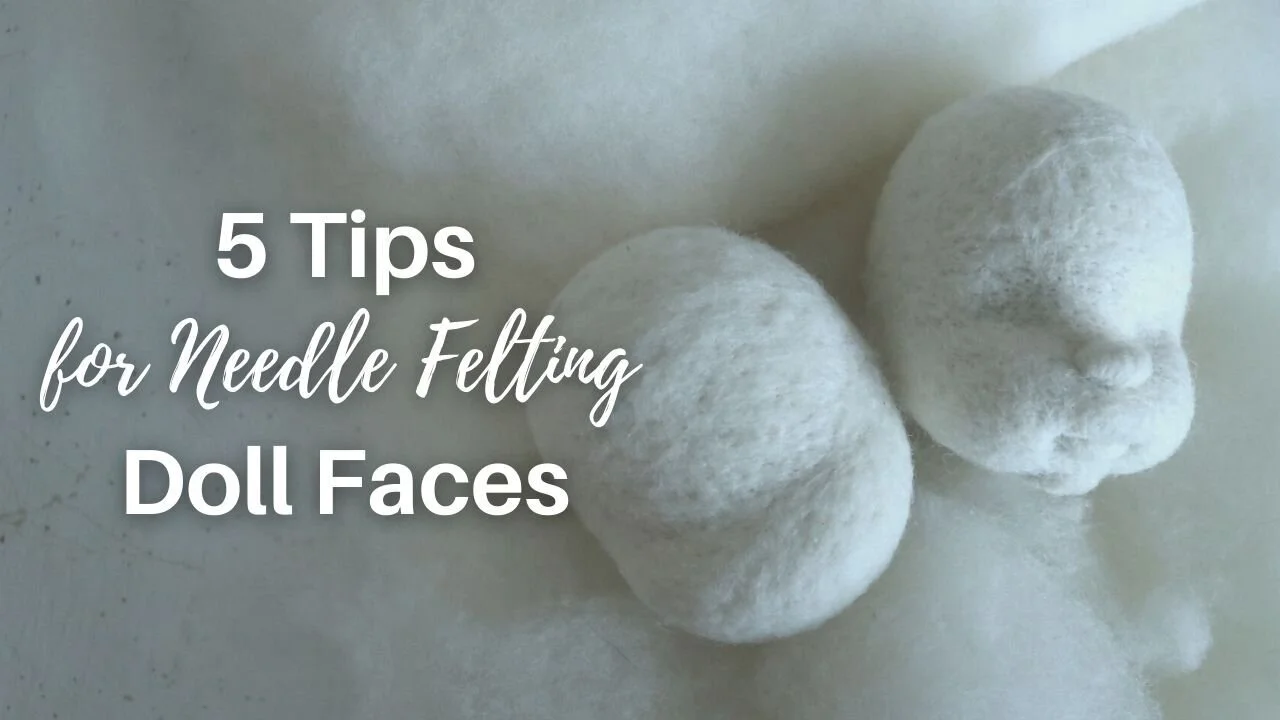
Many dollmakers are drawn to the opportunities needle felting offers. You can customize a simple Waldorf doll’s body or face and add more of your creative essence. It also gives you ways to add movement, shape, and other clever techniques during assembly, especially when you venture into the microcosm of natural fiber art dolls.
But let’s be clear: needle felting natural fiber art dolls is not the same as needle felting art figurines, table dolls, or wool landscapes. Knowledge in any of those areas will still help and give you a small advantage over a total beginner. Mainly, your hand-to-eye coordination will be more accurate, which can save you from painful stabs on your fingertips.
The big difference is that you will cover the entire sculpture in fabric. You need to think in terms of firmness, sturdiness, and smoothness. You will also work entirely with what needle felters call core wool. In the natural fiber art doll world, we simply call it wool batting. This material has fibers going in many different directions (unlike roving, which is combed in one direction). That lets you felt larger areas of the doll much faster.
For now, I can share a few tips if you have already started and you are feeling a little lost.
These tips will come in handy if you have been trying to needle felt doll faces that will later be covered in fabric and you are not quite sure what went wrong or where the mistakes were made.
If you are anything like me and like to learn by the seat of your pants, needle felting will keep you busy for years to come. Please know that you do not have to do all five of these things. They are simply tips that might help you understand how to needle felt a doll’s face better.
Disclaimer: I am a very organic needle-felter. I rarely use strict measurements, though I do like having some guides. Sometimes I just use the quadrants and almost never use a template. But I have seen how these tips help my students who are just learning, so I know they are useful.
My top 5 tips for needle felting doll faces, via fig&me
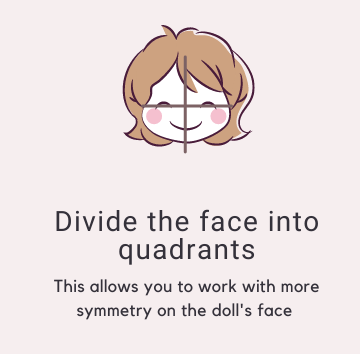
1. Divide the Face into Quadrants
First, I encourage you to divide the face of your doll so you have clear areas to concentrate your stabbing efforts.
Once you start moving the head around, it is easy to lose sight of what is right, what is left, and what is too much. Guidelines placed over the face help you keep track of the top of the doll’s face, where the eyes will go, where the cheeks will be, and so on. They also help you form the face with more symmetry in mind.
Drawing a center line and marking where you want the eye line are two of the most essential divisions you can make. These guides help you decide where everything should be placed. They also train your eye so you can notice if your wool head is not entirely symmetrical and work to bring more balance into the face.
I like to measure from line to line. This helps me see where there is a bigger bump so I can add wool or felt that area down and slowly build the facial features I want.

My top 5 tips for needle felting doll faces, via fig&me
2. Mark the Placement for Each Feature
Marking a placement for each feature helps you see where everything goes and whether you need to make something smaller or larger so the areas fill more harmoniously.
You can check if the nose sits too high or too low on the face. The same goes for the chin, if you want a tiny or wide chin, you can compare it to the nose and the overall face.
I usually make the nose first and then add the chin. After that, you can see how much space remains between those two features. This makes it easier to decide whether a wide or small mouth will look better and how big or protruding the lips should be.
All of these style choices are yours to decide.
My top 5 tips for needle felting doll faces, via fig&me
3. Roll the Facial Features: Nose, Chin and Lips
I encourage you to roll small pieces of wool as tightly as you can without pre-felting them. Add these compacted shapes to your doll’s face so you can sculpt them faster and more easily into the form you want.
For a nose, roll a small ball of wool.
For the chin, roll a more rectangular or square shape. You can then add more layers or reshape it into the chin you want.
For the lips, roll small, tight “worms” or cylinders. These let you shape the lips much faster.
Working with slightly more compacted wool earns you a few brownie points and saves you hours of extra tension in your wrists and fingers.

My top 5 tips for needle felting doll faces, via fig&me
4. Mark the Mouth Line and Sculpt it First
This is one of my favorite tips. I have seen it help many of my students understand how to build all sorts of lips and mouth expressions.
Draw the mouth line first and sculpt it very deep before you add the lower or upper lip. This keeps the shape of the mouth clear in your mind. It also lets you shape the lips to follow the mouth line, rather than placing the lips first and then trying to carve a deep groove between them.
A deep furrow also gives the knit fabric somewhere to sink once you cover the head and face. That deep line is what helps define the doll’s lips and reveals the beautiful wool curves you sculpted.

My top 5 tips for needle felting doll faces, via fig&me
5. Use a Template
I call these “doll templates.” They are very helpful if you are just starting. A template is basically a schematic of your doll’s face with guidelines so you know where to make the divisions and what the spaces or measurements between features should be.
They do not have to be highly technical, you can even draw them yourself. The best approach is to make them the exact size of your finished doll face. That way there is less room for mistakes when converting measurements by percentages.
I will confess that I do not use these templates myself. Still, they are very handy for my students when I teach a specific doll. They guide the process much more easily, and I have come to see their usefulness.
You can make a template for the shape of the head, the finished measurements, and more. From time to time as you needle felt, compare your doll’s head to the template to see how close you are to the intended plan.
With time you may no longer need a template for every face, as your hands and eyes will guide you. But when you are starting out, templates can definitely improve your overall needle felting technique.
Closing Thoughts
That is it for this post on needle felting. I truly hope these tips are helpful and give you food for thought. Perhaps they feel basic because you already do all of them, or perhaps you never thought to approach needle felting a doll face this way.
Either way, thank you for coming over and reading. If you have questions or tips of your own, please leave them in the comments. I love it when people comment on my blog, even if it is just to say thanks.
Wish me a little luck and patience as I put together a longer post that introduces the wonderful world of needle felting natural fiber art dolls. If you would like to read more of my articles on dollmaking, you can find most of them here:
Frequently Asked Questions 🤔
Do I have to needle felt the faces of my natural fiber art dolls?
No. You can make beautiful dolls without it. Needle felting simply gives you more options for firmer features, greater depth of expression, and personal artistic interpretation.
What is the difference between core wool and wool batting?
They are essentially the same material. Needle felters often say “core wool,” while natural fiber art doll makers usually say “wool batting.” The fibers run in many directions, which lets you felt larger areas faster than with roving.
Why should I roll the facial features instead of just stabbing loose wool?
Rolling small pieces into compact balls, squares, or cylinders gives you a firmer starting shape. This speeds up sculpting and reduces strain on your wrists and fingers.
Is a template necessary if I already have some experience?
Not strictly necessary. Many experienced makers (including me) work more organically. Templates are especially helpful for beginners or when you want consistent proportions for a specific doll design.
Can these tips work for other kinds of needle-felted dolls or figures?
They are tailored for faces that will later be covered in fabric. Some principles (like marking guidelines or building firmness) transfer well, but the priorities of firmness, smoothness, and deep furrows are specific to fabric-covered natural fiber art dolls.
Where can I learn more detailed techniques?
I’m currently preparing a full introductory article and video that covers materials, terms, and basic principles. For those who want to go deeper, I also offer two paid needle felting courses: one designed for complete beginners called Needle Felting a Young Child Doll Face and another for more advanced makers called Needle Felting a Baby Doll Face . In the meantime, these five tips are a practical starting point if you’ve already begun exploring.